
Anticipatory Thinking: Why the best leaders think beyond the first outcome
Leadership has always been measured by our ability to solve problems. We celebrate leaders who respond quickly, make difficult decisions under pressure and navigate uncertainty with confidence. These qualities matter, however, they are no longer sufficient for the complexity of the world we now lead.
The question is no longer whether we can solve today's problem, it is whether we understand the problems today's solution may create tomorrow.
Across governments, businesses and communities around the world, I continue asking leaders one question: How do we lead differently to shape a better future?
Anticipatory Thinking
Increasingly, I believe the answer lies in developing anticipatory thinking.
Anticipatory thinking is not the ability to predict the future, it is the discipline of understanding that every decision creates consequences that extend well beyond the moment in which it was made. It asks leaders to move beyond immediate outcomes and develop the capacity to think in systems, relationships, and generations.
This is where the work of Nassim Nicholas Taleb has profoundly influenced my own thinking.
Taleb reminds us that complex systems rarely respond in simple ways. Every intervention produces consequences. Some are immediate and visible while others emerge months or years later, often in places we never expected.
Most leaders stop at first-order thinking: A problem appears, we solve it, the problem disappears. Or so we believe.
Second-order thinking asks what happens because we solved the problem.
Third-order thinking asks how people, systems and behaviours adapt to those new conditions.
Fourth-order thinking asks what entirely new realities emerge that none of us originally anticipated.
This progression changes everything.
Consider education. When government invests millions in increasing access to schools:
First-order thinking celebrates higher enrolments.
Second-order thinking asks whether teachers have the capability to educate larger classrooms effectively.
Third-order thinking considers whether those students graduate with the skills required for an economy transformed by artificial intelligence, automation and global competition.
Fourth-order thinking asks whether the education system itself is developing conscious, adaptable human beings who can navigate a future that has not yet been created.
The investment itself was never wrong but it wasn't complete either.
The same applies to philanthropy. Recently, the world celebrated an extraordinary investment into Malawi. It was a remarkable commitment and one that deserves recognition as financial investment creates opportunity, stimulates economies and restores dignity. These outcomes matter deeply.
Having worked alongside communities at grassroots level, however, I have come to appreciate that economic investment alone cannot transform a nation.
When investment is not accompanied by capacity building, leadership development, financial literacy and education, we risk solving today's challenge while leaving tomorrow's vulnerability untouched.
This is second, third and fourth-order thinking in practice.
The first outcome is economic relief.
The second is increased opportunity.
The third is whether communities possess the capability to sustain that opportunity independently.
The fourth is whether future generations inherit stronger systems because today's leaders invested in people rather than simply programmes.
That is where transformation occurs.
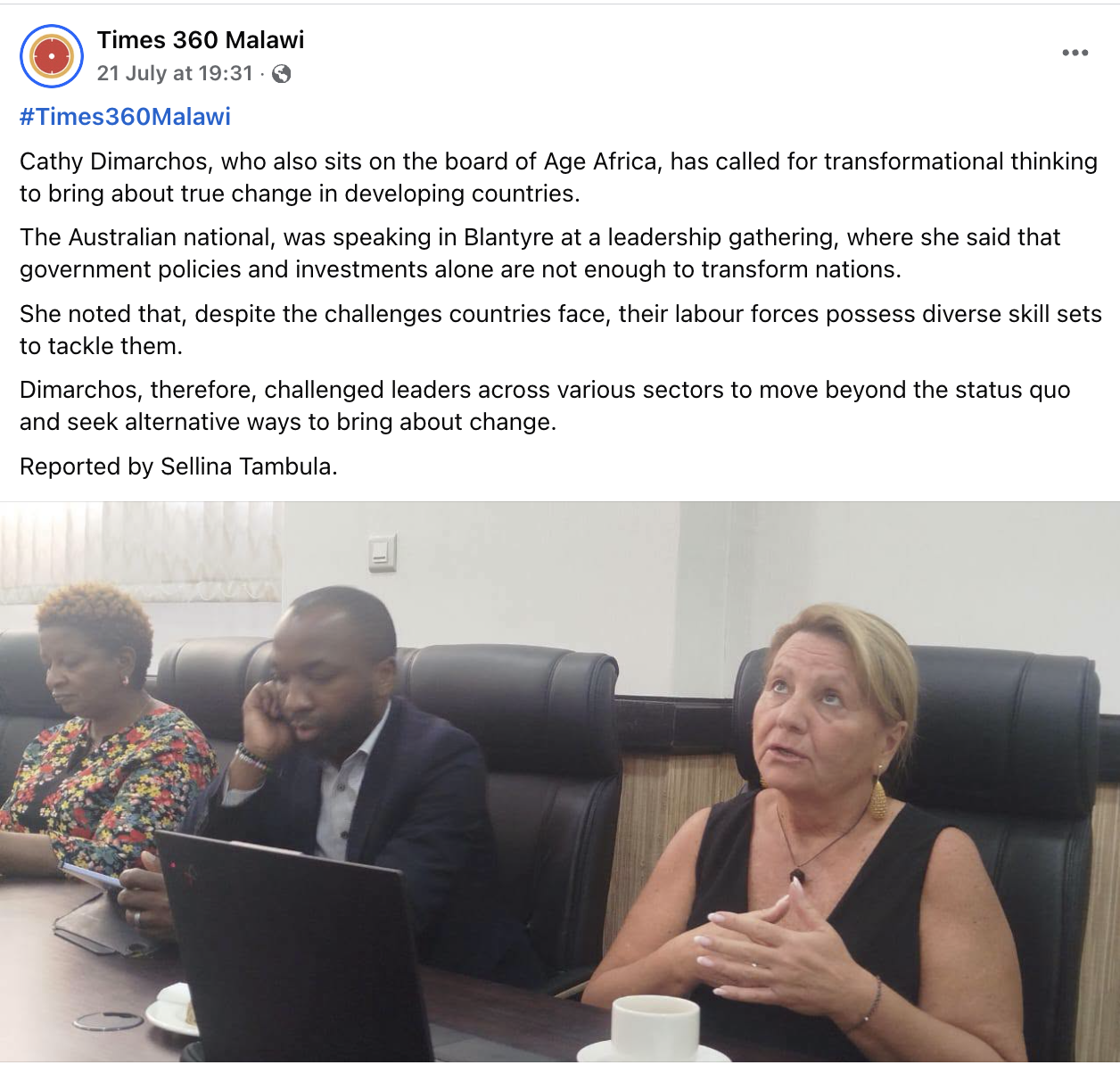
Effecting Real, Meaningful Change
Throughout history, many of our greatest challenges have emerged from well-intentioned decisions that considered only the immediate outcome. We have built economic systems that rewarded productivity while overlooking wellbeing. We have embraced technology before fully considering its influence on identity, relationships and critical thinking. We have pursued growth without always asking what it was costing future generations.
None of these decisions lacked intelligence but many lacked anticipatory thinking.
Leadership today demands something different. It requires us to ask not only whether a decision is effective, but whether it strengthens or weakens the systems upon which future generations will depend.
It requires us to recognise that human behaviour changes in response to incentives, that organisations adapt to the environments we create, and that communities become reflections of the decisions we repeatedly reinforce.
This is why I believe the greatest investment any nation can make is not solely financial, it is investment in human capability.
A person equipped with knowledge can create opportunity.
A person equipped with financial literacy can build economic resilience.
A person equipped with leadership can influence hundreds more.
A community equipped with all three becomes increasingly capable of shaping its own future.
This is the difference between relief and resilience, between intervention and transformation, and between reacting to complexity and preparing people to thrive within it.
Leadership has never been about controlling the future. It has always been about increasing the probability that the future unfolds differently because of the decisions we make today.
Perhaps this is the leadership question we should all be asking.
When history looks back on the decisions we are making today, will it say we solved immediate problems, or that we had the wisdom to strengthen the generations that followed?
