
Identity when we consciously choose
How much of Who we are have we Consciously chosen?
Identity is an interesting concept. Most of us develop a strong sense of who we are long before we ever stop to question how that identity was formed.
We understand ourselves through many different lenses: our family, culture, education, relationships, profession, achievements, failures and life experiences. Over time, these influences contribute to the beliefs we hold about ourselves and the way we behave in the world.
Some of that identity is consciously developed, but much of it is not.
From a very young age, we learn what is valued, what is expected, and what creates belonging. We observe how people respond to us and begin adapting accordingly. We learn whether it is safe to speak, whether achievement earns recognition, whether vulnerability is accepted, whether disagreement creates conflict and what behaviours allow us to feel included.
These experiences do not simply influence our behaviour at the time; repeated often enough, they can become part of the story we tell ourselves about who we are. This is where awareness becomes important.
What have we accepted as identity?
Throughout my work with people and leaders, I have become increasingly interested in the difference between personality, behaviour and identity.
We often describe patterns as though they are permanent characteristics: “I am just someone who takes responsibility,” “I have always been independent,” “I am not good at conflict,” or “I need to be in control.”
Yet, when we become curious about these statements, we may discover that what we have called identity is sometimes nothing more than an adaptation.
Perhaps we developed independence because relying on others did not feel safe. Perhaps achievement became important because recognition was connected to performance. Perhaps we had to learn how to avoid conflict because of an environment where disagreement had consequences.
Understanding this does not require us to diminish our past or analyse every experience; it simply gives us more information about ourselves.
The question then becomes: Is this genuinely who I am, or is this a way of being that I learned?
That distinction matters because something learned can also be reconsidered.
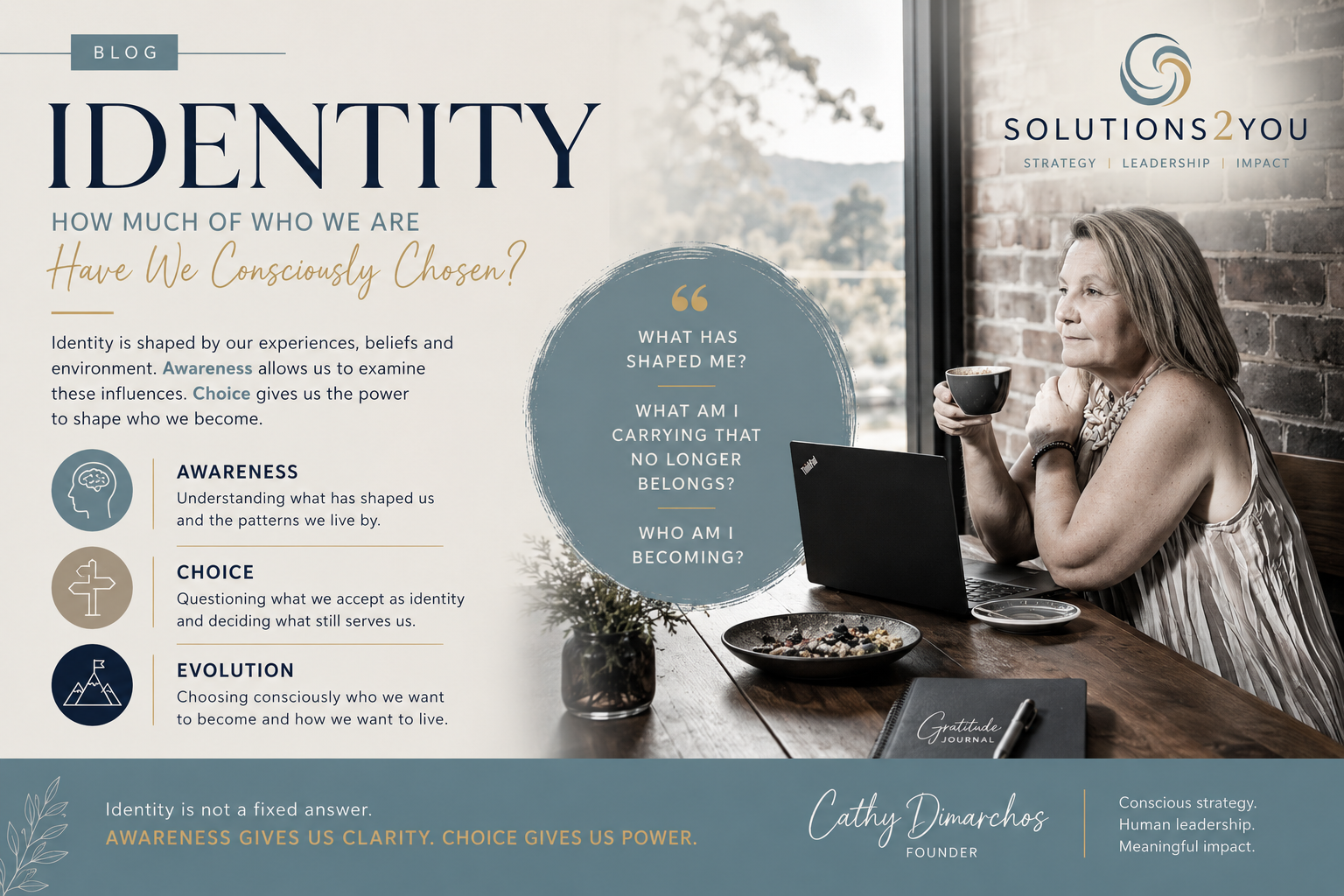
Awareness creates choice
Self-awareness is often discussed as a leadership capability, but I see it as something much broader. Awareness allows us to observe ourselves with enough distance to recognise what is driving our decisions. Without that awareness, we can spend years repeating familiar patterns while still believing we are making conscious choices.
We may remain in a career because it reinforces an identity built around success. We may avoid an opportunity because failure would challenge the way we see ourselves. We may continue being the person everyone depends upon because being needed has become connected to our sense of value.
None of these behaviours are inherently right or wrong but we need to ask ourselves whether they are conscious.
When we understand what is influencing us, we have greater capacity to decide whether we want to continue in the same way. That is where identity becomes less about definition and more about agency.
Identity and the choices we make
We often think the major decisions in life determine who we become, well, I believe our everyday choices are equally important.
How we communicate when we disagree, how we respond when our beliefs are challenged, what we tolerate, where we place our attention, whether our actions align with our values, and how willing we are to reconsider something we once believed to be true all contribute to the person we are becoming.
This is particularly important when we think about leadership. A leader may identify strongly with being decisive, experienced or knowledgeable. Those qualities can be valuable but, if the identity becomes rigid, it can also make it difficult to listen, admit uncertainty or change direction.
Someone who has built their identity around being successful may struggle to acknowledge when the definition of success they have been pursuing no longer feels meaningful. Someone who has always been “the strong one” may find it difficult to ask for help.
The identity itself is not necessarily the problem, the limitation appears when we become so attached to a particular version of ourselves that we stop questioning whether it still serves us or the people around us.
Our values provide a useful reference point
One of the ways we can examine identity is through our values. Most of us can articulate what we believe matters: integrity, family, respect, freedom, contribution, equality, health, courage or perhaps something entirely different.
The more challenging exercise is to examine whether the way we live consistently reflects those values.
If we say people matter but continually prioritise performance at their expense, there is a gap worth examining. If we value integrity but compromise it when there is something significant to lose, there is a conversation worth having with ourselves. If we value freedom but structure our lives entirely around external approval, it is worth asking what is driving that contradiction.
This is not about expecting perfection; human beings are complex and our decisions are influenced by competing needs and responsibilities. It is about developing enough awareness to recognise the difference between the values we identify with and the values we actually practise.
Identity can evolve
Perhaps one of the most important things we can understand about identity is that it does not have to remain fixed.
We can change our thinking without invalidating what we previously believed, we can change direction without regarding the previous path as a mistake, we can reconsider what success means, we can become more comfortable with uncertainty, and we can develop new qualities that were not encouraged in earlier stages of our lives.
Evolution does not require us to reject who we have been but it does, however, require us to remain aware enough to recognise when an old identity is influencing a new decision.
There have been many times in my own life when I have had to question what I believed about myself, what success meant, what I was responsible for, and what I wanted the next stage of my life and work to represent. Those questions have rarely produced immediate answers. What they have done, though, is create greater clarity about what I am consciously choosing and why.
Perhaps that is a more useful way to think about identity. Not as a fixed answer to “Who am I?”, but as an ongoing examination of what has shaped me, what I value, what I am choosing and whether the way I am living reflects the person I intend to be.
When we become more aware of what has shaped our identity, we give ourselves greater choice over what continues to shape it.
That choice influences more than our own lives. It affects how we lead, how we raise families, how we build organisations, how we participate in communities and how we contribute to the systems around us.
Identity therefore deserves more than a label. It deserves our attention.
